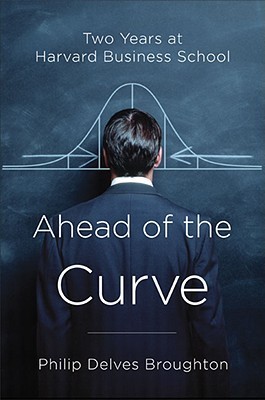
Ahead of the Curve: Two Years at Harvard Business School
ISBN: 9780143115434
Date read: 2024-01-08
How strongly I recommend it: 6/10
Get the book or see my list of books
My notes
"Cost of goods sold," or COGS, is simply the cost to the manufacturer of the goods it has sold in a given period. "Inventory" is the cost to the manufacturer of the goods it is waiting to sell. Divide COGS by inventory and you get a pretty good idea of how fast the company is shifting product. A ratio of one tells you that the company holds exactly as much inventory as it sells in the period covered by the balance sheet.
ratios. Banks, I heard someone say authoritatively, tended to have huge short-term liabilities—otherwise known as the money in their customers’ accounts, which could be withdrawn at any time—and similarly huge amounts of receivables, or loans made to its customers. For banks, loans are assets, while the money it holds for its customers is a liability. It took me a while to get this straight. The money they have is a liability, whereas the money they have given away is an asset.
Before arriving at Harvard, we were required to take two personality tests. The first was the Myers-Briggs Type Indicator, the second was called CareerLeader.
Forer principle. In 1948, the psychologist Bertram Forer
to be critical of yourself. While you have some personality weaknesses you are generally able to compensate for them. You have considerable unused capacity that you have not turned to your advantage. Disciplined and self- controlled on the outside, you tend to be worrisome and insecure on the inside. At times you have serious doubts as to whether you have made the right decision or done the right thing. You prefer a certain amount of change and variety and become dissatisfied when hemmed in by restrictions and limitations. You also pride yourself as an independent thinker; and do not accept others’ statements without satisfactory proof. But you have found it unwise to be too frank in revealing yourself to others. At times you are extroverted, affable and sociable, while at other times you are introverted, wary and reserved. Some of your aspirations tend to be rather unrealistic.
To get comfortable with being a little bit immodest, go over your key ‘selling points’ before every interview."
cash conversion cycle—the period between when it paid for goods and when it was paid for them
Some companies tend to outpace a rising market, such as luxury goods, and some perform poorly in good times but soar when the rest of the economy sours, such as debt collection
During our study group sessions, Alan consoled me: "Number games are what consultants play all day long," he said. "They reach big conclusions from a handful of numbers. You know, they get the aspirin sales for one store and the number of people who use the store, then they figure out that number as a percentage of the people who live in the area, then they apply the percentage to the entire population of the United States, and now they gross up the sales at that one store and they’ve got a pretty good estimate of national aspirin sales. It’s like a party trick. It sounds great at first, but it gets old fast."
"What Is Strategy?," that laid out the five forces he believed determined a company’s ability to capture value. They are: barriers to entry, supplier power, customer power, substitutes, and rivalry.
Since Porter came up with his five forces, a couple more have been added. Complements are those products that might enhance your own. In the computer business, complements to a PC include software and printers. Better software or printers make the PC more desirable. Beautiful shirts and ties are the complement to well-made suits. Nurturing these complementary businesses can have a positive effect on your own business. For some businesses, especially those that are highly regulated, government is the seventh force. No major media company, for example, can ignore the workings of the Federal Communications Commission.
But first we had to understand the notion of competitive advantage. It came in two flavors: either you had a cost advantage, whereby you made things cheaper and sold them cheaper, or you differentiated your product somehow, either by making it better than your rivals or by designing it differently to appeal to a different group of people. These two forms of differentiation were known as vertical or horizontal: vertical meant better or worse; horizontal meant different. If you had two cars and one had a better engine, brakes, and interior than the other, they were vertically differentiated; one was simply better than the other. But if you had two identical cars, but one was pink and one black, they were horizontally differentiated, appealing to different kinds of customer. One nightmare for a business is to have no advantage, to be neither the cheapest to produce nor clearly differentiated. This was to be "stuck in the middle."
But the hallmark of ethically bad businesspeople," Gregor said, "is that generally they don’t break the law, because more often than not they had a hand in drafting the law. They write laws, through their lobbyists, so they don’t have to break them. But you still wouldn’t want them as godparents to your children."
Gandhi: "Live as if you were to die tomorrow. Learn as if you were to live forever."
But there would be a fleeting moment for the buyer who spotted the lower price to buy the cheaper bananas and sell them at the higher price before everyone else in the market saw what was going on and dropped their prices. He would be the arbitrageur. Arbitrage is the making of a riskless profit. You sell one product and immediately buy an identical product at a lower price with the funds from the sale.
Some of this was basic human psychology. People buy lottery tickets despite the staggering odds against them. As an investment on the riskreward spectrum, it makes no sense. But on the brightening-my-dismal-week-with-the-faint-hope-of-escaping-the-rat-hole-that-is-my-life spectrum, it makes perfect sense. Trying to price out and assess the worst possible scenarios in one’s life, however rational, is no fun at all. So we tend to avoid it. Or overpay for insurance. The profits in the insurance business, after all, arise almost entirely from the difference between the consumer’s and the insurer’s capacities to assess and price risk. I found that trying to apply whatever financialconcepts I actually grasped to nonfinancial situations made understanding Dynamic Markets easier.
Peter Drucker, the great authority on late-twentieth-century management, wrote that "An employer has no business with a man’s personality. Employment is a specific contract calling for specific performance . . . Any attempt to go beyond this is usurpation. It is immoral as well as an illegal intrusion of privacy. It is abuse of power. An employee owes no ‘loyalty,’ he owes no ‘love’ and no ‘attitudes’—he owes performance and nothing else."
all he saw of his two children were their outlines under their blankets when he left in the morning and when he returned late at night. "I’ve been watching my children grow longer,"
People are delighted to accept pensions and gratuities, for which they hire out their labor or their support or their services. But nobody works out the value of time: men use it lavishly as if it cost nothing.
— SENECA, ON THE SHORTNESS OF LIFE
Comparison is the death of happiness. We are all we have. No one else will rescue us
One thing I had learned from studying so many entrepreneurs was that if you were going to start up a business, you had better be ready for a lot of thankless hard work while you got it off the ground.