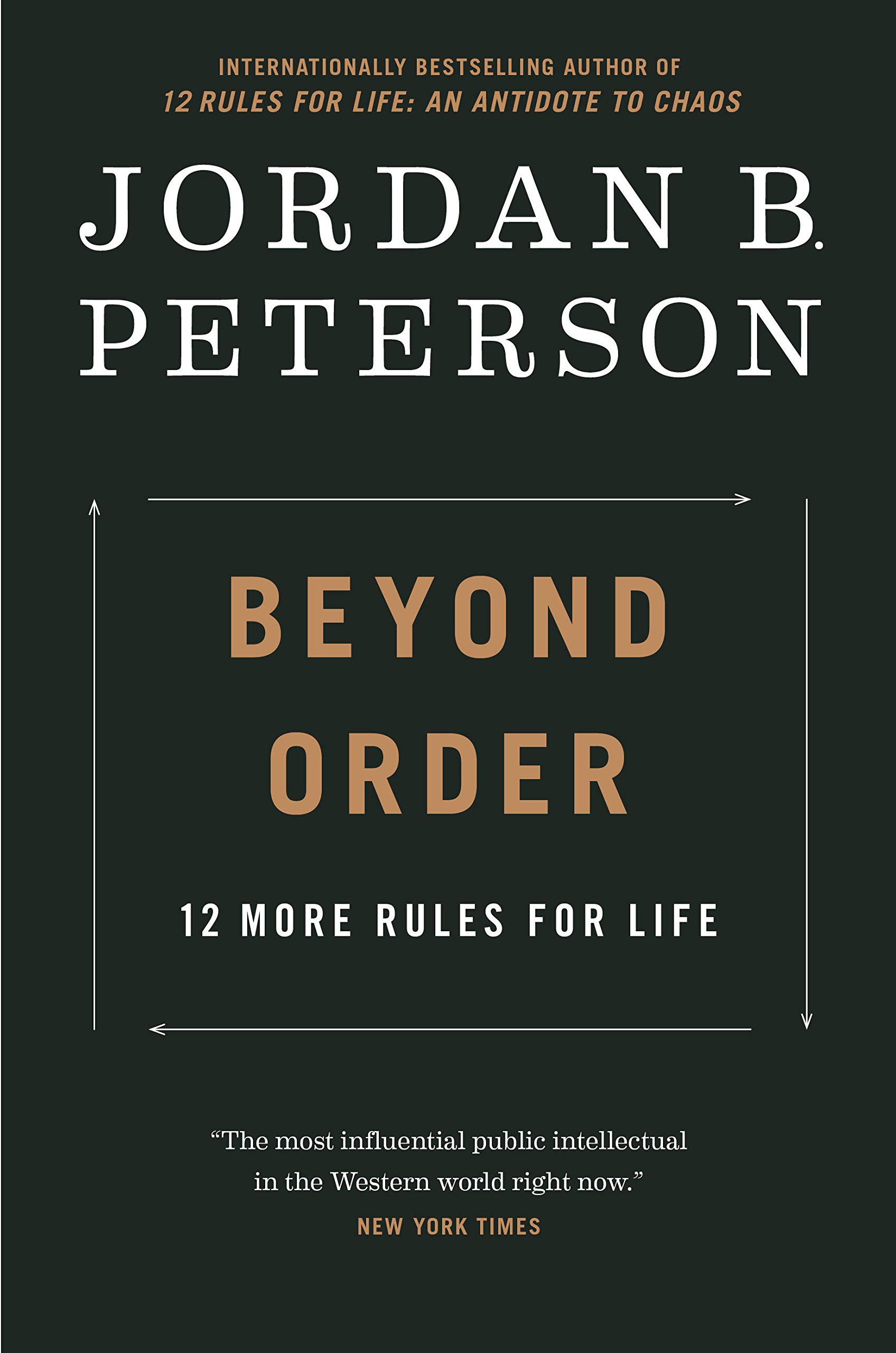
Beyond Order: 12 More Rules For Life
ISBN: 9780593084649
Date read: 2024-03-01
How strongly I recommend it: 6/10
Get the book or see my list of books
My notes
had come to realize over my more than twenty years of psychological practice: people depend on constant communication with others to keep their minds organized. We all need to think to keep things straight, but we mostly think by talking
the role of the community in the maintenance of personal mental health.
It is for such reasons that I assess the position of all my new clinical clients along a few dimensions largely dependent on the social world when I first start working with them: Have they been educated to the level of their intellectual ability or ambition? Is their use of free time engaging, meaningful, and productive? Have they formulated solid and well-articulated plans for the future? Are they (and those they are close to) free of any serious physical health or economic problems? Do they have friends and a social life? A stable and satisfying intimate partnership? Close and functional familial relationships? A career—or, at least, a job—that is financially sufficient, stable and, if possible, a source of satisfaction and opportunity? If the answer to any three or more of these questions is no, I consider that my new client is insufficiently embedded in the interpersonal world and is in danger of spiraling downward psychologically because of that
One of the things that has constantly amazed me is the delight that decent people take in the ability to provide opportunities to those over whom they currently exercise authority. I have experienced this repeatedly: personally, as a university professor and researcher (and observed many other people in my situation doing the same); and in the business and other professional settings I have become familiar with. There is great intrinsic pleasure in helping already competent and admirable young people become highly skilled, socially valuable, autonomous, responsible professionals. It is not unlike the pleasure taken in raising children, and it is one of the primary motivators of valid ambition. Thus, the position of top dog, when occupied properly, has as one of its fundamental attractions the opportunity to identify deserving individuals at or near the beginning of their professional life, and provide them with the means of productive advancement.
Those who rise to the top can do so through manipulation and the exercise of unjust power, acting in a manner that works only for them, at least in the short term; but that kind of ascendance undermines the proper function of the hierarchy they are nominally part of. Such people generally fail to understand or do not care what function the organization they have made their host was designed to fulfill. They extract what they can from the riches that lie before them and leave a trail of wreckage in their wake.
Now, there is nothing wrong, in principle, with the expression of concern for planet-wide issues. That is not the point. There is something wrong, however, with overestimating your knowledge of such things—or perhaps even considering them—when you are a mid-twenty-year-old with nothing positive going on in your life and you are having great difficulty even getting out of bed. Under those conditions, you need to get your priorities straight, and establishing the humility necessary to attend to and solve your own problems is a crucial part of doing just that.
Excuse the cliché, but it is necessary to walk before you can run. You may even have to crawl before you can walk. This is part of accepting your position as a beginner, at the bottom of the hierarchy you so casually, arrogantly, and self-servingly despise. Furthermore, the deeply antihuman attitude that often accompanies tears shed for environmental degradation and man’s inhumanity to man cannot but help but have a marked effect on the psychological attitude that defines a person’s relationship to him or herself.
the other, although they exist in genuine tension. This means, first,
Every rule was once a creative act, breaking other rules. Every creative act, genuine in its creativity, is likely to transform itself, with time, into a useful rule. It is the living interaction between social institutions and creative achievement that keeps the world balanced on the narrow line between too much order and too much chaos. This is a terrible conundrum, a true existential burden. We must support and value the past, and we need to do that with an attitude of gratitude and respect. At the same time, however, we must keep our eyes open—we, the visionary living—and repair the ancient mechanisms that stabilize and support us when they falter. Thus, we need to bear the paradox that is involved in simultaneously respecting the walls that keep us safe and allowing in enough of what is new and changing so that our institutions remain alive and healthy.
People are more commonly upset by what they did not even try to do than by the errors they actively committed while engaging with the world.2 At least if you misstep while doing something, you can learn from doing it wrong. But to remain passive in the face of life, even if you excuse your inaction as a means of avoiding error—that is a major mistake. As the great blues musician Tom Waits insists (in his song "A Little Rain"): "You must risk something that matters."
The you for whom you are caring is a community that exists across time. The necessity for considering this society of the individual, so to speak, is a burden and an opportunity that seems uniquely characteristic of human beings.
If you place people in situations where they are feeling a lot of positive emotion, they get present-focused and impulsive. This means "make hay while the sun shines"—take your opportunities while things are good and act now. But now is by no means everything, and unfortunately, everything must be considered, at least insofar as you are able. In consequence, it is unlikely that whatever optimizes your life across time is happiness. I am not denying its desirability, by the way. If happiness comes to you, welcome it with gratitude and open arms (but be careful, because it does make you impetuous).
What might serve as a more sophisticated alternative to happiness? Imagine it is living in accordance with the sense of responsibility, because that sets things right in the future. Imagine, as well, that you must act reliably, honestly, nobly, and in relationship to a higher good, in order to manifest the sense of responsibility properly. The higher good would be the simultaneous optimization of your function and the function of the people around you, across time, as we have discussed previously. That is the highest good.
Furthermore, the fact that you are not pursuing the goal you should rightly be pursuing means that you are feeling guilty, ashamed, and lesser at the same time.
This is not a helpful strategy. It is not going to work. I have never met anyone who was satisfied when they knew they were not doing everything they should be doing. We are temporally aware creatures: We know that we are continually and inescapably playing an iterated game from which we cannot easily hide.
And if what you are doing in your day-to-day activity is not enough, then you are not aiming at the construction of a proper cathedral. And that is because you are not aiming high enough. Because if you were, then you would experience the sense of meaning in relationship to your sufficiently high goal, and it would justify the misery and limitations of your life. If you have something meaningful to pursue, then you are engrossed in life. You are on a meaningful path. The most profound and reliable instinct for meaning—if not perverted by self-deceit and sin (there is no other way to state it)—manifests itself when you are on the path of maximum virtue.
"Blackboard" was mentioned, as was "master key" (the former perhaps because referring to anything as "black"—even if it is black—is somehow racist in our hypersensitive times; the latter because of its hypothetical relationship to terminology historically associated with slavery). My client tried to make sense of what she was witnessing: "Such discussions give people the superficial sense of being good, noble, compassionate, openhearted, and wise. So, if for the sake of argument anyone disagrees, how could that person join the discussion without being considered anticompassionate, narrow minded, racist and wicked?"
the other companies she has worked for as thoroughly possessed by the current linguistic and identity-politics fads as her original place of employment
We do the things we wish we would not do and do not do the things we know we should do. We want to be thin, but we sit on the couch eating Cheetos and despairing. We are directionless, confused, and paralyzed by indecision. We are pulled in all directions by temptations, despite our stated will, and we waste time, procrastinate, and feel terrible about it, but we do not change.
It is possible to be content, or even happy, with one partner or another, or with one group of friends or another, or with one career or another. In some sense, the satisfaction that these arrangements bring could have been generated by different choices. They are also each deeply flawed: romantic partners can be fickle and complex, as can friends, and every career or job is characterized by frustration, disappointment, corruption, arbitrary hierarchy, internal politics, and sheer idiocy of decision making. We could conclude from that lack of specific or ideal value that nothing matters more than anything else—or to draw the even more hopeless allied conclusion that nothing therefore matters at all. But those who draw such conclusions, no matter how well armed they are with rationally coherent arguments, pay a high price. People suffer for it if they quit before completing an undergraduate degree or the study of a trade.
"Man shall not live by bread alone" (Matthew 4:4). That is exactly right. We live by beauty. We live by literature. We live by art. We cannot live without some connection to the divine—and beauty is divine—because in its absence life is too short, too dismal, and too tragic. And we must be sharp and awake and prepared so that we can survive properly, and orient the world properly, and not destroy things, including ourselves—and beauty can help us appreciate the wonder of Being and motivate us to seek gratitude when we might otherwise be prone to destructive resentment.
Make yourself colorful, stand out, and the lions will take you down. And the lions are always there.
If you stick your neck out, then the sword will come. Many, many cultures have a saying like that. The English version? "The poppy that grows higher than the rest is the first one to have its head removed by the scythe." In Japan: "The nail that sticks up above the rest is the first to get hit by the hammer."
A truthful person can rely on his or her innate sense of meaning and truth as a reliable guide to the choices that must be made through life’s days, weeks, and years. But there is a rule that applies—the same rule that computer programmers well know: "garbage in, garbage out." If you deceive (particularly yourself), if you lie, then you begin to warp the mechanisms guiding the instinct that orients you. That instinct is an unconscious guide, so it works underneath your cognitive apparatus, especially once it has become habitual. If you rewire the unconscious mechanisms that maintain you with assumptions derived from something you know to be unreal, then your meaningful instinct will take you places you should not go, in proportion to its corruption. There is little more terrifying than the possibility that you could come to a crisis point in your life when you need every faculty you possess, at that moment, to make the decision properly, only to find you have pathologized yourself with deceit and can no longer rely on your own judgment. Good luck to you, because nothing but luck will then serve to save you.
"To hell with it" is a multifaceted philosophy. It means "This is worth sacrificing anything for." It means "Who cares about my life. It is not worth anything, anyway." It means "I do not care if I have to lie to those who love me—my parents, my wife and children—because what difference does it make, anyway? What I want is the drug." There is no easy coming back from that.
When you habitually engage in deceit, you build a structure much like the one that perpetuates addiction, especially if you get away with it, however briefly. The success of the lie is rewarding—and if the risks were high, and you are not caught out, that successful reward might well be intense. This reinforces the development of the neural mechanism in your brain comprising the structure of the entire system of deception. With continued success, at least in the short term, this mechanism begins to work with increasing automaticity—and comes to act, in its arrogant manner, knowing that it can get away with it.
The same holds true for the issue of gratitude. I do not believe you can be appropriately grateful or thankful for what good you have and for what evil has not befallen you until you have some profound and even terrifying sense of the weight of existence. You cannot properly appreciate what you have unless you have some sense not only of how terrible things could be, but of how terrible it is likely for things to be, given how easy it is for things to be so. This is something that is very much worth knowing. Otherwise you might find yourself tempted to ask, "Why would I ever look into the darkness?" But we seem positively drawn to look. We are fascinated by evil. We watch dramatic representations of serial killers, psychopaths, and the kings of organized crime, gang members, rapists, contract killers, and spies. We voluntarily frighten and disgust ourselves with thrillers and horror films—and it is more than prurient curiosity. It is the development of some understanding of the essentially moral structure of human existence, of our suspension between the poles of good and evil. The development of that understanding is necessary; it places a down below us and an up above us, and orients us in perception, motivation, and action. It protects us, as well. If you fail to understand evil, then you have laid yourself bare to it. You are susceptible to its effects, or to its will. If you ever encounter someone who is malevolent, they have control over you in precise proportion to the extent that you are unwilling or unable to understand them. Thus, you look in dark places to protect yourself, in case the darkness ever appears, as well as to find the light. There is real utility in that.
If you truly love someone, it can seem a deep form of betrayal to stay integrated and healthy, in essence, in their absence or sadly waning presence. What does that ability indicate, after all, about the true depths of your love? If you can witness their demise and survive the loss, does that not imply that the bond was shallow and temporary, and even replaceable? If you were truly bonded, should not it destroy you (as it sometimes does)? But we cannot wish that every inevitable loss leads to the destruction of everyone affected, because we would then all be doomed, far more immediately than we currently are. And it certainly is not the case that the last wish of the dying is or should be the interminable suffering of those they love. My impression has been, instead, that people tend to feel guilty on their deathbeds (because of their immediate uselessness and the burden that causes, but even more because of their apprehension about the grief and trouble they will cause those left behind). Thus, their most fervent wish, I believe, is that those whom they love will be able to move forward and live happily, after a reasonable time of mourning.