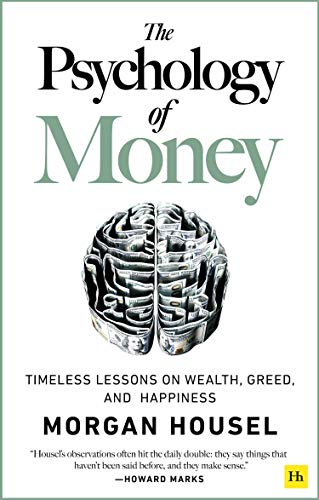
The Psychology of Money
ISBN: 9780857197689
Date read: 2022-12-23
How strongly I recommend it: 10/10
Get the book or see my list of books
My notes
Voltaire’s observation that "History never repeats itself; man always does." It applies so well to how we behave with money
$412 a year on lotto tickets, four times the amount of those in the highest income groups. Forty percent of Americans cannot come up with $400 in an emergency. Which is to say: Those buying $400 in lottery tickets are by and large the same people who say they couldn’t come up with $400 in an emergency. They are blowing their safety nets on something with a one-in-millions chance of hitting it big.
We live paycheck-to-paycheck and saving seems out of reach. Our prospects for much higher wages seem out of reach. We can’t afford nice vacations, new cars, health insurance, or homes in safe neighborhoods. We can’t put our kids through college without crippling debt. Much of the stuff you people who read finance books either have now, or have a good chance of getting, we don’t. Buying a lottery ticket is the only time in our lives we can hold a tangible dream of getting the good stuff that you already have and take for granted. We are paying for a dream, and you may not understand that because you are already living a dream. That’s why we buy more tickets than you do.
Jim Simons, head of the hedge fund Renaissance Technologies, has compounded money at 66% annually since 1988. No one comes close to this record. As we just saw, Buffett has compounded at roughly 22% annually, a third as much. Simons’ net worth, as I write, is $21 billion. He is—and I know how ridiculous this sounds given the numbers we’re dealing with—75% less rich than Buffett.
Why the difference, if Simons is such a better investor? Because Simons did not find his investment stride until he was 50 years old. He’s had less than half as many years to compound as Buffett. If James Simons had earned his 66% annual returns for the 70-year span Buffett has built his wealth he would be worth—please hold your breath—sixty-three quintillion nine hundred quadrillion seven hundred eighty-one trillion seven hundred eighty billion seven hundred forty-eight million one hundred sixty thousand dollars.
Its magic is that the higher your margin of safety, the smaller your edge needs to be to have a favorable outcome.
The hardest thing about this was that I loved the work. And I wanted to work hard. But doing something you love on a schedule you can’t control can feel the same as doing something you hate. There is a name for this feeling. Psychologists call it reactance.
Even if using leverage left you wiped out when you were young (if you use two-to-one margin a 50% market drop leaves you with nothing) the researchers showed savers would still be better off in the long run so long as they picked themselves back up, followed the plan, and kept saving in a two-to-one leveraged account the day after being wiped out
Graham advocated purchasing stocks trading for less than their net working assets—basically cash in the bank minus all debts. This sounds great, but few stocks actually trade that cheaply anymore—other than, say, a penny stock accused of accounting fraud.
One of Graham’s criteria instructs conservative investors to avoid stocks trading for more than 1.5 times book value. If you followed this rule over the last decade you would have owned almost nothing but insurance and bank stocks. There is no world where that is OK.
You have to survive to succeed. To repeat a point we’ve made a few times in this book: The ability to do what you want, when you want, for as long as you want, has an infinite ROI.
The biggest single point of failure with money is a sole reliance on a paycheck to fund short-term spending needs, with no savings to create a gap between what you think your expenses are and what they might be in the future. The trick that often goes overlooked—even by the wealthiest—is what we saw in chapter 10: realizing that you don’t need a specific reason to save. It’s fine to save for a car, or a home, or for retirement. But it’s equally important to save for things you can’t possibly predict or even comprehend—the financial equivalent of field mice. Predicting what you’ll use your savings for assumes you live in a world where you know exactly what your future expenses will be, which no one does. I save a lot, and I have no idea what I’ll use the savings for in the future. Few financial plans that only prepare for known risks have enough margin of safety to survive the real world.
Sunk costs—anchoring decisions to past efforts that can’t be refunded—are a devil in a world where people change over time. They make our future selves prisoners to our past, different, selves. It’s the equivalent of a stranger making major life decisions for you.
Bubbles form when the momentum of short-term returns attracts enough money that the makeup of investors shifts from mostly long term to mostly short term.
John Stuart Mill wrote in the 1840s: "I have observed that not the man who hopes when others despair, but the man who despairs when others hope, is admired by a large class of persons as a sage."
Even if you don’t own stocks, those kind of things will grab your attention. Only 2.5% of Americans owned stocks on the eve of the great crash of 1929 that sparked the Great Depression. But the majority of Americans—if not the world—watched in amazement as the market collapsed, wondering what it signaled about their own fate. This was true whether you were a lawyer or a farmer or a car mechanic.
Historian Eric Rauchway writes:
This fall in value immediately afflicted only a few Americans. But so closely had the others watched the market and regarded it as an index of their fates that they suddenly stopped much of their economic activity. As the economist Joseph Schumpeter later wrote, "people felt that the ground under their feet was giving way."
Assuming that something ugly will stay ugly is an easy forecast to make. And it’s persuasive, because it doesn’t require imagining the world changing. But problems correct and people adapt. Threats incentivize solutions in equal magnitude. That’s a common plot of economic history that is too easily forgotten by pessimists who forecast in straight lines.
A third is that progress happens too slowly to notice, but setbacks happen too quickly to ignore.
Use money to gain control over your time, because not having control of your time is such a powerful and universal drag on happiness. The ability to do what you want, when you want, with who you want, for as long as you want to, pays the highest dividend that exists in finance.
Be nicer and less flashy. No one is impressed with your possessions as much as you are. You might think you want a fancy car or a nice watch. But what you probably want is respect and admiration. And you’re more likely to gain those things through kindness and humility than horsepower and chrome.
Save. Just save. You don’t need a specific reason to save. It’s great to save for a car, or a downpayment, or a medical emergency. But saving for things that are impossible to predict or define is one of the best reasons to save. Everyone’s life is a continuous chain of surprises. Savings that aren’t earmarked for anything in particular is a hedge against life’s inevitable ability to surprise the hell out of you at the worst possible moment.
Economist Hyman Minsky described the beginning of debt crises: The moment when people take on more debt than they can service. It’s an ugly, painful moment. It’s like Wile E. Coyote looking down, realizing he’s screwed, and falling precipitously.
But the response to 2008, necessary as it may have been, perpetuated some of the trends that got us here.
Quantitative easing both prevented economic collapse and boosted asset prices, a boon for those who owned them—mostly rich people.
The Fed backstopped corporate debt in 2008. That helped those who owned that debt—mostly rich people.
Tax cuts over the last 20 years have predominantly gone to those with higher incomes. People with higher incomes send their kids to the best colleges. Those kids can go on to earn higher incomes and invest in corporate debt that will be backstopped by the Fed, own stocks that will be supported by various government policies, and so on.
of these things are problems in and of themselves, which is why they stay in place. But they’re symptomatic of the bigger thing that’s happened since the early 1980s: The economy works better for some people than others. Success isn’t as meritocratic as it used to be and, when success is granted, it’s rewarded with higher gains than in previous eras.